

On August 6, 1945, the world changed forever. A comprehensive, authenticated timeline of the Hiroshima bombing, its immediate aftermath, and the enduring legacy of peace that emerged from tragedy.
August 6, 1945, remains one of the most significant dates in human history. On this day, at 8:15 AM local time, the United States dropped an atomic bomb nicknamed "Little Boy" on the Japanese city of Hiroshima during World War II. This was the first use of a nuclear weapon in warfare, an event that would claim an estimated 140,000 lives by the end of 1945 and fundamentally alter the course of human history.
This comprehensive timeline documents the authenticated sequence of events from the morning of August 6 through the immediate aftermath, the long-term consequences, and the peace movement that emerged from this tragedy. Every detail is sourced from historical records, survivor testimonies, and official documentation.
World War II Background
The Pacific War
By mid-1945, World War II in the Pacific had raged for nearly four years. Japan, despite severe losses, refused to accept the Allied demand for unconditional surrender outlined in the Potsdam Declaration of July 26, 1945. The United States, seeking to end the war quickly and avoid a costly invasion of the Japanese mainland, made the decision to use the newly developed atomic bomb.
The Manhattan Project
The atomic bomb was developed under the top-secret Manhattan Project, led by the United States with support from the United Kingdom and Canada. The project employed over 130,000 people and cost nearly $2 billion (approximately $23 billion in 2026 dollars). The bomb dropped on Hiroshima, "Little Boy," was a uranium gun-type bomb with an explosive yield equivalent to 15 kilotons of TNT.
Three B-29 Superfortress weather reconnaissance aircraft took off from Tinian Island in the Mariana Islands. Their mission was to report weather conditions over Hiroshima, Kokura, and Nagasaki — the three primary target cities. Clear skies over Hiroshima sealed its fate as the primary target.
The B-29 bomber Enola Gay, piloted by Colonel Paul Tibbets and named after his mother, took off from Tinian Island. The aircraft carried the "Little Boy" atomic bomb and a crew of 12. Aboard were also two other B-29s: The Great Artiste (instrumentation aircraft) and Necessary Evil (photography aircraft).
The Enola Gay approached Hiroshima. The city had been largely spared from conventional bombing raids, making it a "clean" target to assess the atomic bomb's destructive power. At this altitude of 31,000 feet, the crew could see the city clearly below through the bomber's Norden bombsight.
At precisely 8:15:17 AM, the Enola Gay released "Little Boy" over the center of Hiroshima. The bomb fell for 43 seconds before detonating at approximately 1,900 feet (580 meters) above the Shima Surgical Clinic (now Hiroshima Peace Memorial Hospital). The explosion occurred directly over the heart of the city.
The atomic bomb detonated with a force equivalent to 15 kilotons of TNT. The explosion created:
- A fireball with a temperature of over 3,000°C (5,432°F) — hotter than the surface of the sun
- A massive shockwave traveling faster than the speed of sound
- Intense thermal radiation causing instant burns
- Prompt radiation exposure
- The iconic mushroom cloud rising to 40,000 feet
An estimated 70,000 people were killed instantly or died within the first few hours.
Within minutes of the explosion:
- Nearly 70% of the city's buildings were destroyed or severely damaged
- Fires erupted across the city, eventually merging into a firestorm
- Survivors suffered from severe burns, radiation sickness, and traumatic injuries
- Medical facilities were overwhelmed; many hospitals were destroyed
- Communication systems collapsed
The Enola Gay crew observed the destruction from 11.5 miles away and reported: "We could see the city disappearing under the smoke and fire."
While en route back to Tinian Island, President Harry S. Truman announced the use of the atomic bomb from aboard the USS Augusta in the Atlantic Ocean. He stated: "Sixteen hours ago an American airplane dropped one bomb on Hiroshima, an important Japanese Army base. That bomb had more power than 20,000 tons of TNT."
In the days immediately following the bombing:
- Thousands more died from injuries, burns, and radiation sickness
- "Black rain" — radioactive fallout mixed with ash and debris — fell over the city and surrounding areas
- Survivors (later called hibakusha) began searching for family members
- Medical personnel worked under impossible conditions with limited supplies
- Relief efforts were hampered by the scale of destruction
💔 Immediate Casualties (By End of 1945)
- Deaths: Approximately 140,000 people (±10,000)
- Civilian deaths: The vast majority were civilians
- Military personnel: Approximately 20,000 Japanese soldiers
- Injured: Over 100,000 people injured
- Missing: Thousands never found
️ Long-Term Effects
- Radiation sickness: Thousands suffered acute radiation syndrome
- Cancer rates: Significantly elevated cancer rates among survivors
- Birth defects: Increased rates in children born to survivors
- Psychological trauma: Lifelong PTSD and social stigma
- By 1950: Death toll estimated at 200,000+
🏙️ Physical Destruction
- Buildings destroyed: Approximately 69% of all buildings
- Area devastated: Over 4 square miles (10 km²)
- Infrastructure: Water, gas, and electrical systems destroyed
- Hospitals: Most medical facilities destroyed or damaged
- Industrial capacity: Completely eliminated
🌍 Historical Significance
- First use of nuclear weapons in warfare
- Contributed to Japan's surrender on August 15, 1945
- Ended World War II
- Began the nuclear age
- Sparked the Cold War arms race
️ The Peace Movement Emerges
Hiroshima Peace Memorial
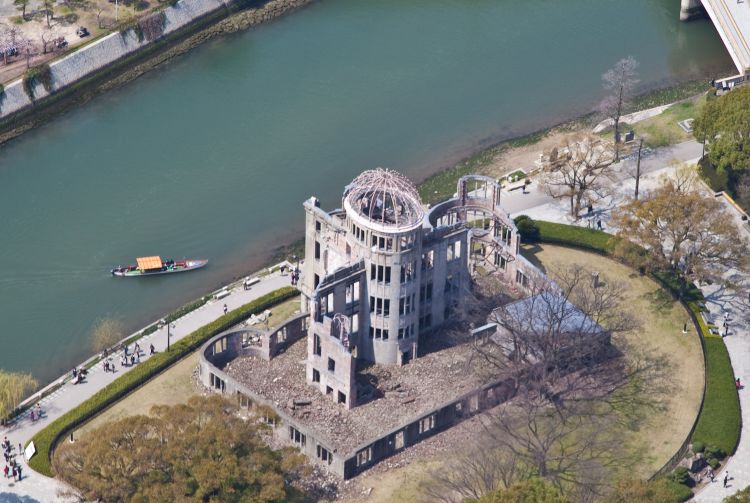
The Genbaku Dome (Atomic Bomb Dome), the only structure left standing near the hypocenter, was preserved as a memorial. It was designated a UNESCO World Heritage Site in 1996 and stands as a powerful symbol of the devastation caused by nuclear weapons and the commitment to peace.
Annual Peace Memorial Ceremony
Every August 6, Hiroshima holds a Peace Memorial Ceremony at the Hiroshima Peace Memorial Park. The ceremony includes:
- A moment of silence at 8:15 AM (the exact time of the bombing)
- The ringing of the Peace Bell
- The release of doves symbolizing peace
- The reading of the Peace Declaration
- Lantern floating ceremony on the Motoyasu River
The Hibakusha (Survivors)
The hibakusha (atomic bomb survivors) have become powerful advocates for nuclear disarmament and world peace. Their testimonies have educated generations about the humanitarian consequences of nuclear weapons. As of 2026, the average age of survivors is over 85, making their mission to share their stories even more urgent.
Peace Declaration
Each year, the Mayor of Hiroshima delivers a Peace Declaration calling for the abolition of nuclear weapons. The declaration emphasizes: "No more Hiroshimas" and advocates for a world free of nuclear weapons through diplomacy and international cooperation.
🌏 Global Observances
- Japan: National day of remembrance
- UN: International Day for the Total Elimination of Nuclear Weapons (August 29)
- Schools: Educational programs about peace and nuclear disarmament
- Peace museums: Special exhibitions and survivor testimonies
- Religious institutions: Prayer services for peace
📚 Educational Impact
- Hiroshima Peace Memorial Museum receives over 1 million visitors annually
- Survivor testimonies preserved in digital archives
- Peace education programs in schools worldwide
- Academic research on nuclear weapons and disarmament
- Art, literature, and films inspired by Hiroshima
August 6, 1945, changed the world forever. The bombing of Hiroshima demonstrated the terrifying destructive power of nuclear weapons and marked the beginning of the nuclear age. The immediate devastation was unprecedented, but the long-term suffering of survivors continued for decades.
Yet from this tragedy emerged a powerful movement for peace. The hibakusha, the preserved ruins of the Genbaku Dome, and the annual Peace Memorial Ceremony serve as constant reminders of the human cost of war and the urgent need for nuclear disarmament.
As we commemorate Hiroshima Day, we honor the memory of the 140,000+ lives lost and the countless others who suffered. We listen to the voices of survivors who have dedicated their lives to preventing nuclear war. And we recommit ourselves to building a world where such destruction can never happen again.
The words inscribed at the Hiroshima Peace Memorial resonate across generations: "Let all the souls here rest in peace, for we shall not repeat the evil."


 Posts

